Grab your free gift, our online Houseboat Magazine, when you sign up!

Are pontoon house boats any good? They're popular, and seen everywhere.
What are pontoon house boats, and why are there so very many around? The main reason is because they are safe and easy to operate, require little maintenance, and so reasonably priced compared to cruisers or yachts.Pontoon houseboats are popular
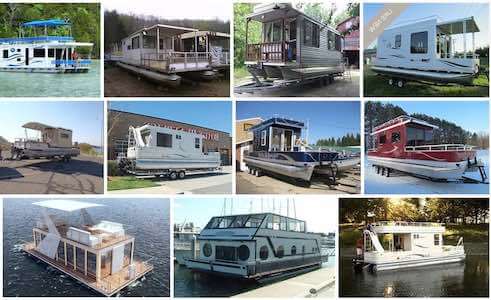
If you're looking to buy a new pontoon houseboat, we have some special pricing available to our readers. We've teamed up with one of the leading aluminum pontoon houseboat manufacturers in the industry, and because of this we can offer you special new boat quotes here.
Basics about Pontoon Houseboats
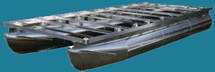 |
Pontoon cylindrical tubes are the basic hull that the rest is built upon and range from 12 to 80+ ft. They are generally made of Marine Grade Aluminum, and can be made of Steel, Fiberglass, Plastic, Wood. Because of buoyancy, the smaller boats have two pontoons, and the bigger heavier boats use three due to the weight being carried. |
| Small sized Pontoon Boats range from 20-30ft and are great for day or weekend getaways. Because of their size, they can be trailerable, and great for exploring new waters. | 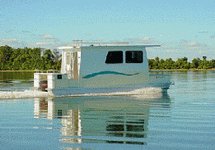 |
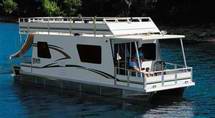 |
Medium sized Pontoon Boats range from 25-45 ft and are better equipped for sleeping, cooking, and living aboard. |
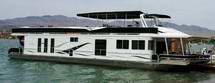
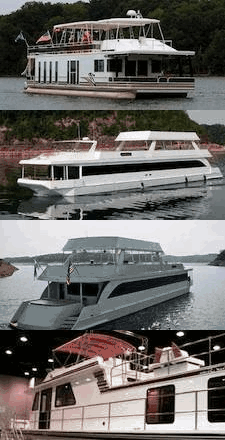
Large sized Pontoon Boats range from 40-75ft or more, and are the "mega" boats that are becoming very popular. They generally have all the space and comforts of home. |
 |
Video on Pontoon House Boats
Pontoon Houseboat Questions
You will notice that they range from smaller ones of @ 18-25ft, middle sized boats from 25-45ft, and now builders are making them in the luxury 75-80 ft range mega boats. There's boats for any use or budget.
One of the common materials for pontoon construction is "marine grade" aluminum, however they can be made from fiberglass, steel, wood, and even plastic now. Read more about pontoon houseboat construction.
A good way to calculate the buoyancy of pontoons, is to use the figure of 180/lbs per foot of pontoon tube length, and this provides half submersion.
You'll find three pontoons often on larger heavier houseboats that require more buoyancy. I haven't noticed any major difference in ride or handling.
You can find boats with either single, or twin engines. Single engines are generally more fuel efficient, however twin installations provide better maneuverability. Installations are often outboards, I/O, or sterndrive(s).
On medium and larger sized boats you will find roof decks and flybridges, which are great for navigating, sunbathing, storage, and entertaining.
Yes, you can build your own houseboat. You can find plans and designs to suit any style or budget. There's a layout for any size family or project.
They are very safe since pontoon construction is similar to taking soft drink cans, and welding them together, end to end. So in the event of a major impact, and a leak was to occur, only one chamber would have water in it.
Because of the "low freeboard" you will find them mostly on lakes, rivers, and bays. They weren't designed for coastal or ocean going applications.
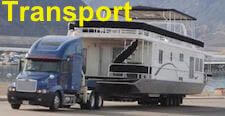
The smaller pontoon house boats are "trailerable", however the larger ones are transportable with specialized equipment to haul, tow, & launch them. The height and width become a concern and so does the vehicle towing it.
Build your own Pontoon Houseboats
If the idea of building your own boat is on your list of things to do, than rest assured, with tools, material, and friends, it can now easily be done.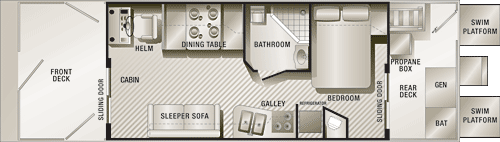
Here are some of our articles that will be of interest to you.
 Download It Now |
Continue Reading Our Popular Pages
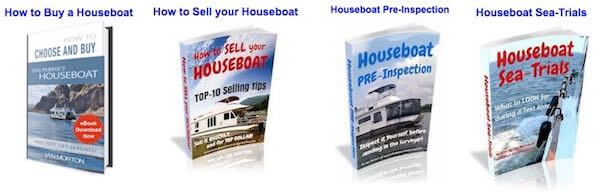
Our collection of houseboat ebooks
We just love houseboats, do you?
Join our monthly HB Insider for free
|
|
Grab your Free Giftvisiting us, here's a free gift. It's our online Houseboat Magazine  IAN, the editor & founder.  Free Houseboat Magazine Start living the passion & freedom, download the boat-buying guide.  Visit our SponsorsWest MarineAmazon Marine 
Boat US membership Fiberglass Products Holding Tank Vents Canvas & Zipper Repair Bilge Water Level Alarm Propco Houseboat Props Financing Boat Loans Inflatable Water Toys Boat Building Supplies Houseboat Transport Boat Marina For Sale Bow & Stern Thrusters PWC Rails & Jet Ski Lifts Waste Pump-Out Adapter Tow your Dinghy, PWC, etc Put your Business Here!  Advertise Now for 50% off |





|
|
Questions? Contact Us - Email Inquiries. Visit our Site Sponsors. View our Privacy Policy, Disclaimer, Disclosure pages.
Copyright © 2006 - 2025 www.all-about-houseboats.com
The information or articles on this website are for educational purpose only. It is not intended to replace the advice of a professional. To pay all the expenses, All-About-Houseboats may derive a small financial benefit from affiliate, third party links, and/or advertising. This site does not take responsibility for the accuracy of comments, opinions, suggestions and any other messages posted by visitors. We are a participant in the Amazon Services LLC Associates Program, an affiliate advertising program designed to provide a means for us to earn fees by linking to Amazon.com and affiliated sites.