
How to Lift and Block Houseboats for Storage?
by Steve
(Fond du Lac, WI)
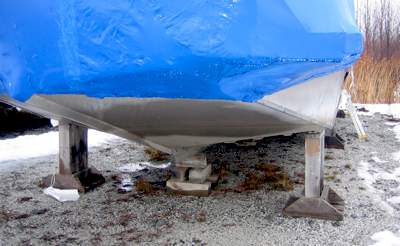

Typical houseboat blocking with multiple blocks.
How to go about lifting and blocking a houseboat for winter storage? I just purchased a 1969 Nautaline houseboat, 34 foot, single Chrsyler 318.
I was wondering about the proper way to go about how to block this houseboat for winter storage. I have received multiple "opinions" One "Expert: suggests most of the weight on the keel with just braces to keep it upright.
The second "expert" says the house boat has should have most of the weight on the chine, with just a foam block under the engine area.
I am confused, and looking to find the proper way to lift and block a houseboat.
Please help, Thank you in advance, Steve
 increase sales and profits with targeted traffic? Act now to get our 1/2 price sale, limited offer |
Reply - Answer
Well Steve, congratulations on your houseboat purchase, and the Nautaline's is a popular houseboat model with good interior and exterior space, and they still have traditional classic style.
As to the "proper method" to block a houseboat, I'm sure we will get many opinions on this. From my experience, I have always seen or tried to block my boat in a way that the weight is evenly spread
Some of the important aspects to properly blocking a houseboat are to take into account some of the environmental issues like wind, and the ground stability. Nothing worse than going to see your houseboat and the wind or the soft ground has allowed it to topple over :(
It is my understanding that the keel or the chine should be able to handle all the weight of the houseboat, but from a "stability" point of view, boats are generally "blocked" all the way around.
If you're getting an opinion to block more of the weight on the chine, could be because the keel is soft, and they don't want to take the risk of damage? Has the houseboat, and the hull been professionally surveyed by a qualified marine surveyor?
Lastly, hopefully some of our readers will share and post comments about their houseboat blocking and lifting experiences. Feel free to use the "Click here to post comments." link found at the bottom of this page.
Thanks again for sharing, IAN from all-about-houseboats
Free Bonus Offer |
Comments for How to Lift and Block Houseboats for Storage?
|
||
|
||
|
||
|
||


Continue Reading Our Popular Pages
Our collection of houseboat ebooks

We just love houseboats, do you?
Join our monthly HB Insider for free
|
|
Grab your Free Giftvisiting us here's a free gift, it's our online Houseboat Magazine  IAN, the editor & founder.  Free Houseboat Magazine Start living the passion & freedom, download the boat-buying guide.  Visit our SponsorsWest MarineAmazon Marine 
Boat US membership Fiberglass Products Holding Tank Vents Canvas & Zipper Repair Bilge Water Level Alarm Propco Houseboat Props Financing Boat Loans Inflatable Water Toys Boat Building Supplies Houseboat Transport Boat Marina For Sale Bow & Stern Thrusters PWC Rails & Jet Ski Lifts Waste Pump-Out Adapter Tow your Dinghy, PWC, etc Put your Business Here!  Advertise Now for 50% off |









|
|
Questions? Contact Us - Email Inquiries. Visit our Site Sponsors. View our Privacy Policy, Disclaimer, Disclosure pages.
Copyright © 2006 - 2020 www.all-about-houseboats.com
The information or articles on this website are for educational purpose only. It is not intended to replace the advice of a professional.
To pay all the expenses, All-About-Houseboats may derive a small financial benefit from affiliate, third party links, and/or advertising.
This site does not take responsibility for the accuracy of comments, opinions, suggestions and any other messages posted by visitors.
We are a participant in the Amazon Services LLC Associates Program, an affiliate advertising program designed to provide a means for us to earn fees by linking to Amazon.com and affiliated sites.